
Home > Fireplace Blog > How Much Does It Cost to Run a Gas Fireplace in 2026?
Gas fireplaces are one of the most affordable ways to heat a room, but "affordable" means different things depending on your fuel type, your fireplace's output, and where you live. Many homeowners choose a gas fireplace because it makes the living area feel cozy without the hassle of traditional fireplaces, but the real question before committing to one for home heating is: what will it actually cost to run?
You need more than a vague average. You need the right numbers, a clear picture of energy consumption, and a way to calculate your own costs.
Here's what gas fireplace running costs look like in 2026, what drives those costs up or down, and how to estimate yours before the next heating season.
What Does It Cost to Run a Gas Fireplace in 2026?
The issue isn't the fire itself. It's convective heat which is the warm air that naturally rises from a gas fireplace and travels upward along the wall above it.
On average, running a gas fireplace costs between $0.20 and $1.00+ per hour, depending on whether you're burning natural gas or propane, the BTU output of your unit, and how much fuel costs in your area.
For most homeowners running their fireplace three to four hours per day during the colder months, that works out to roughly $40 to $190 per month, or an annual cost of approximately $400 to $900+ per heating season.
The formula is straightforward:
(Fireplace BTU rating × fuel cost per therm) ÷ 100,000 = cost per hour
A 30,000-BTU natural gas fireplace at $1.40 per therm costs about $0.42 per hour. That same unit running on propane, where a gallon of propane equals roughly 91,500 BTUs and costs around $2.50–$3.00 per gallon, would cost closer to $0.80–$1.00 per hour.
These numbers give you a useful starting point, but many factors can push your actual costs higher or lower. Understanding what drives your gas fireplace running cost is the first step toward knowing where you can save money.
Natural Gas vs. Propane: How Fuel Type Affects Your Costs
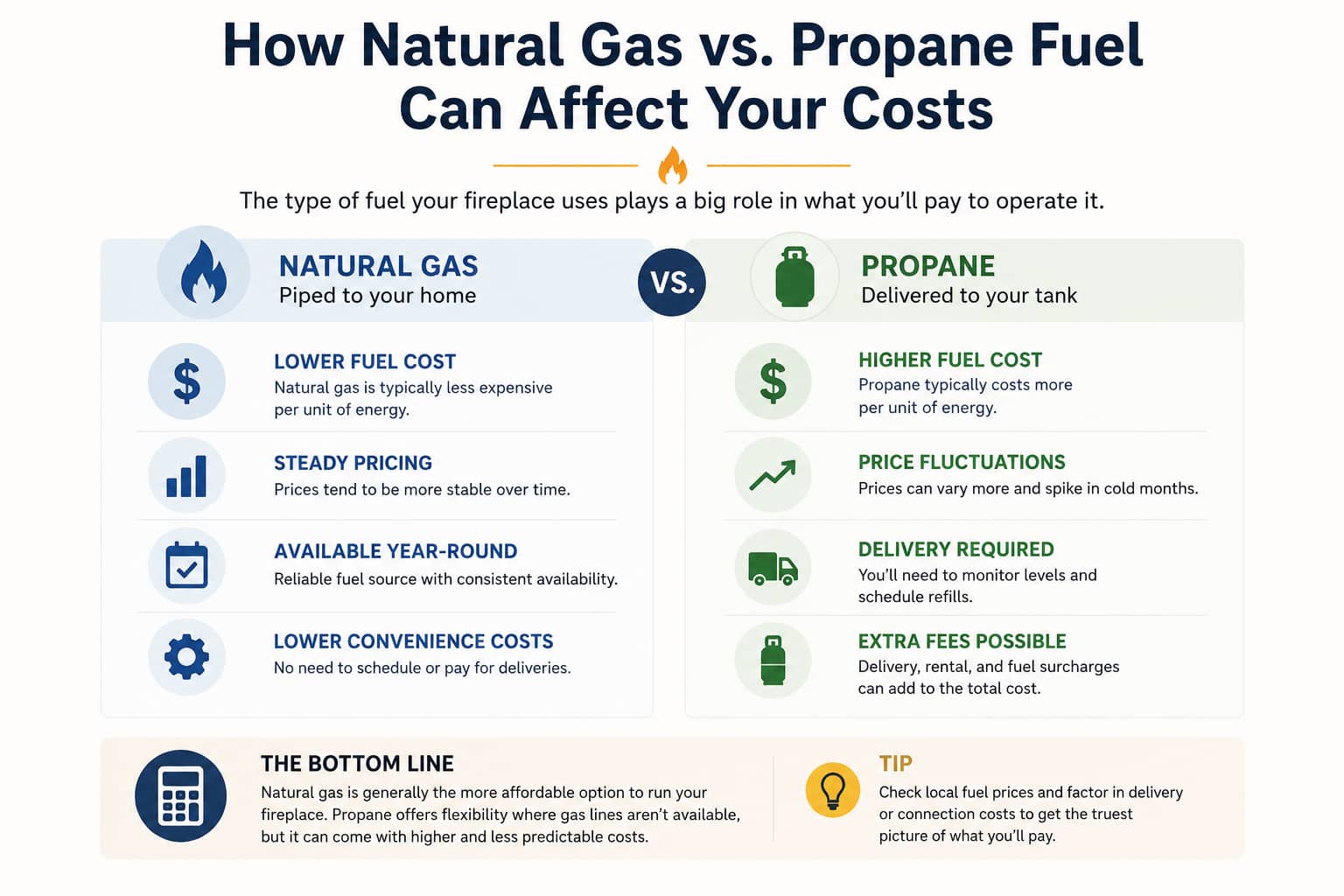
The single biggest variable in your gas fireplace running cost is which fuel you're burning.
Natural gas is typically the cheaper option. It's priced per therm. One therm equals 100,000 BTUs, and current U.S. averages sit in the range of $1.20 to $1.60 per therm, though this varies by state and provider. If your home already has a natural gas line, you're connected to a steady, cost-effective supply.
Propane is more common in rural areas without natural gas infrastructure, and for some homeowners, it's the only option. It's priced per gallon, and the national average currently hovers around $2.50 to $3.00 per gallon. Since one gallon of propane contains roughly 91,500 BTUs, a higher-output fireplace will burn through fuel faster, and your propane costs will climb accordingly.
In practical terms, propane fireplaces often cost roughly 1.5 to 2 times more to operate per hour than comparable natural gas units. If you're weighing both options during a new build or renovation, the long-term operating cost difference is worth factoring into the decision, especially if you plan to use the fireplace as a regular heat source.
Six Factors That Affect Your Gas Fireplace Running Cost
Fuel type sets the baseline, but several other factors determine where you actually land on the cost spectrum.
1. BTU Output
BTU (British Thermal Unit) rating tells you how much heat your fireplace produces per hour. Gas fireplaces typically deliver between 20,000 and 40,000 BTUs per hour, making them capable of heating entire floors or open-concept spaces effectively. Some larger units push past 50,000 BTUs, while compact models designed for bedrooms or dens may sit closer to 10,000–15,000 BTUs.
The relationship between BTU output and running cost is direct: higher output means higher fuel consumption per hour. A 40,000-BTU fireplace costs roughly twice as much to run as a 20,000-BTU unit burning the same fuel at the same rate. Choosing a unit sized appropriately for your room means you avoid paying to produce heat you don't need.
To size this for your own room, see how many BTUs your fireplace needs.
2. Local Fuel Prices
Natural gas and propane prices vary considerably by region. A homeowner in Texas may pay noticeably less per therm than someone in New England. Rates also shift seasonally because winter demand often pushes prices higher during exactly the months you're using the fireplace most.
Check your local utility provider or propane supplier for current rates before running your own cost estimate.
3. Usage Hours
This is the factor you have the most control over. Running your fireplace for two hours each evening costs half as much as running it for four. If you treat the fireplace as supplemental heat for a single room, rather than expecting it to replace your gas furnace or central heating system, your operational costs stay manageable.
This is where zone heating becomes a practical strategy. Instead of cranking up the furnace for the entire house, you heat only the space you're using. A gas fireplace in the living room paired with a lowered thermostat elsewhere can actually reduce your overall energy bill. Some homeowners even use fireplaces in more than one room to create targeted warmth across different zones without running the central system at full capacity.
4. Home Insulation and Room Size
A well-insulated, properly sealed room holds heat more efficiently, meaning your fireplace doesn't need to run as long or as high to maintain temperature. Older homes with drafty windows, poor insulation, or spaces that aren't air tight will require more gas usage to achieve the same comfort level.
Room volume matters too. Heating a compact 300-square-foot room is a very different job than heating a 1,000-square-foot great room with high ceilings.
5. Pilot Light
If your fireplace has a standing pilot light, which is a small flame that stays lit continuously, it's consuming fuel even when the fireplace isn't in use. A standing pilot typically uses 600 to 1,500 BTUs per hour, which can add $10 to $20 or more per month to your gas bill.
Many modern gas fireplaces use electronic ignition instead, which eliminates pilot light costs entirely. If your unit has a standing pilot, consider turning it off during warmer months when the fireplace isn't needed.
6. Climate and Locations
Where you live determines how often and how long you run the fireplace. A homeowner in British Columbia or Minnesota will log far more burn hours per season than someone in a mild climate where the fireplace is only used occasionally.
Wind, altitude, and outdoor temperatures also affect how hard the fireplace works to maintain indoor comfort, especially in exposed or poorly sheltered rooms.
Why Fireplace Efficiency Matters for Running Costs
Not all gas fireplaces convert fuel into heat at the same rate, and the efficiency gap has a real impact on what you spend over a heating season. This is where Annual Fuel Utilization Efficiency (AFUE) comes in. It measures the percentage of fuel that's actually converted into usable heat. High-efficiency gas fireplaces can achieve AFUE ratings of 70% to 90%, meaning most of the fuel you're burning becomes warmth for the room. Older or lower-quality units may operate at only 30% to 40% efficiency, effectively wasting more than half the fuel you're paying for.
Direct vent gas fireplaces tend to sit at the higher end of that heating efficiency range. They use a sealed combustion system that draws air from outside and expels combustion gases through exterior vents, which improves indoor air quality and reduces heat loss compared to units that pull heated room air for combustion. Because the system is properly vented and properly sealed, there's also a reduced risk of carbon monoxide entering the living area, which is an important safety consideration.
Ventless gas fireplaces operate differently. They release combustion byproducts directly into the room and can approach near-100% energy efficiency on paper, but they come with air quality trade-offs and local code restrictions that limit where and how they can be used.
Models that deliver radiant heat, which warms people and surfaces directly rather than just circulating hot air, can also feel more comfortable at lower settings, which means less gas usage and lower operational costs over time.
If you're comparing two fireplaces with similar BTU ratings, the one with a higher efficiency rating will cost less to operate. Look for both efficiency and heat output when evaluating options. A unit that is energy efficient and properly sized for your space will consistently deliver the best balance of comfort and cost.
For what the published figures actually mean, see gas fireplace efficiency ratings.

How to Calculate Your Own Gas Fireplace Cost
You don't need to rely on averages. With three numbers, you can estimate your exact hourly cost.
Step 1: Find your fireplace's BTU rating. This is listed in the owner's manual or on the unit's data plate. For example, a Valor G3 gas insert is rated at 24,000 BTU/h on high and 6,500 BTU/h on low. Fireplace inserts, which are designed to fit into existing masonry openings where traditional fireplaces once sat, often fall in the 20,000 to 35,000 BTU range and tend to be among the most energy-efficient options available.
Step 2: Find your local fuel cost per therm. For natural gas, check your utility bill or provider's website. For propane, check your supplier's current per-gallon rate and convert: one gallon of propane ≈ 0.915 therms.
Step 3: Apply the formula:
(BTU rating × cost per therm) ÷ 100,000 = hourly cost
Example: natural gas at $1.40 per therm:
- High flame: (24,000 × $1.40) ÷ 100,000 = $0.34 per hour
- Low flame: (6,500 × $1.40) ÷ 100,000 = $0.09 per hour
At those rates, running the fireplace on high for four hours a day costs about $1.36 per day, or roughly $41 per month. On low, it drops to $0.36 per day, or around $11 per month.
That's meaningful warmth for a very manageable cost, especially when you consider that the fireplace is heating the room you're actually using rather than pushing warm air through ductwork to empty rooms. For a deeper breakdown of operating costs across different fuel types and fireplace categories, Valor's costs of operating a fireplace resource page includes additional calculation guidance and regional rate references.
.jpg)
Gas or Electric Fireplace: How Operating Costs Compare
If you're deciding between a gas or electric fireplace, operating cost is one area where gas generally comes out ahead, especially for real heating applications.
Electric fireplaces run on household electricity, and most residential models max out around 5,000 BTUs (approximately 1,500 watts). At the current U.S. average electricity rate of roughly $0.17 per kWh, that's about $0.25 per hour, for significantly less heat output than a mid-range natural gas fireplace.
A gas fireplace producing the same 5,000 BTUs of heat from natural gas would cost roughly $0.07–$0.08 at average rates. When you need real, room-filling warmth during the winter months, especially in colder climates, gas fireplaces deliver more heat per dollar of energy use.
Electric fireplaces have their place. They're easier to install, require no venting, and work well in spaces where gas infrastructure isn't available. You also won't need to budget for log sets, annual gas inspections, or combustion venting. But if your primary goal is energy efficient heating that can warm a room and offset your central heating system, gas is typically the more cost-effective choice over time.
How to Lower Your Gas Fireplace Running Costs
You can't control fuel prices, but you can control how efficiently you use your fireplace. A few practical adjustments can make a noticeable difference over a full heating season.
Use zone heating intentionally. Rather than heating the whole house to the same temperature, turn down the central thermostat and use the fireplace to warm the room where you spend the most time. This approach can reduce your overall heating bill, even though the fireplace itself is consuming fuel.
Size the fireplace to the room. An oversized unit produces more heat than needed and burns more fuel than necessary. Work with a dealer to match BTU output to the room's square footage, ceiling height, and insulation quality.Maintain the unit annually. Annual inspections of gas fireplaces are recommended for both safety and efficiency, and typically cost approximately $75 to $150. A qualified technician will check the burner, ignition system, venting, and gas connections, catching small issues before they become expensive repairs or efficiency drains.
Turn off the pilot when not in use. If your unit has a standing pilot, shutting it off during off-season months eliminates a steady background fuel draw.
Improve room insulation. Sealing drafty windows, adding weatherstripping, or improving wall insulation helps the room retain heat longer, reducing how often the fireplace needs to cycle on or run at a higher setting.
For another way to cut running costs, read about pairing a gas fireplace with a heat pump.
A Note on Installation Costs
This article focuses on running costs, the ongoing expense of operating your gas fireplace. But if you're still in the planning stage, it's worth knowing that installation costs are a separate line item. The installation cost of a gas fireplace can range significantly, with estimates reaching up to $5,000 or more depending on the complexity of the project and the type of fireplace chosen. Factors like running a new gas line, ensuring proper venting, and meeting local building code requirements can all add to the total. A licensed professional should assess your home before installation to ensure everything is sized, vented, and connected safely.
Once installed, though, the operating costs outlined above are what you'll see reflected on your monthly bills, and they're where the long-term value of a gas fireplace becomes clear.

Final Thoughts
A gas fireplace is one of the most efficient and controllable ways to add real warmth to your home. For most homeowners, the gas fireplace running cost falls somewhere between $0.20 and $1.00 per hour, with natural gas sitting at the lower end and propane at the higher end.
The actual number depends on your unit's BTU rating, your local fuel prices, how many hours you run it, and how well your space retains heat. But with a simple formula and a few minutes of research into your local rates, you can estimate your own cost to run a gas fireplace with confidence.
The key insight is this: a gas fireplace doesn't need to heat your entire home to save you money. Used strategically, warming the room you're in while dialing back the central system, it becomes both a comfort upgrade and a practical part of your home heating strategy.
Table of Contents